Bosnia and Herzegovina
The Sarajevo–Ploče Railway: Europe's Most Underrated Mountain Mainline
Last updated: 4 May 2026
A 194 km, fully electrified standard-gauge line that hauls bauxite and steel through one of Europe's most spectacular river canyons — and as of November 2025, carries passengers across the border again.
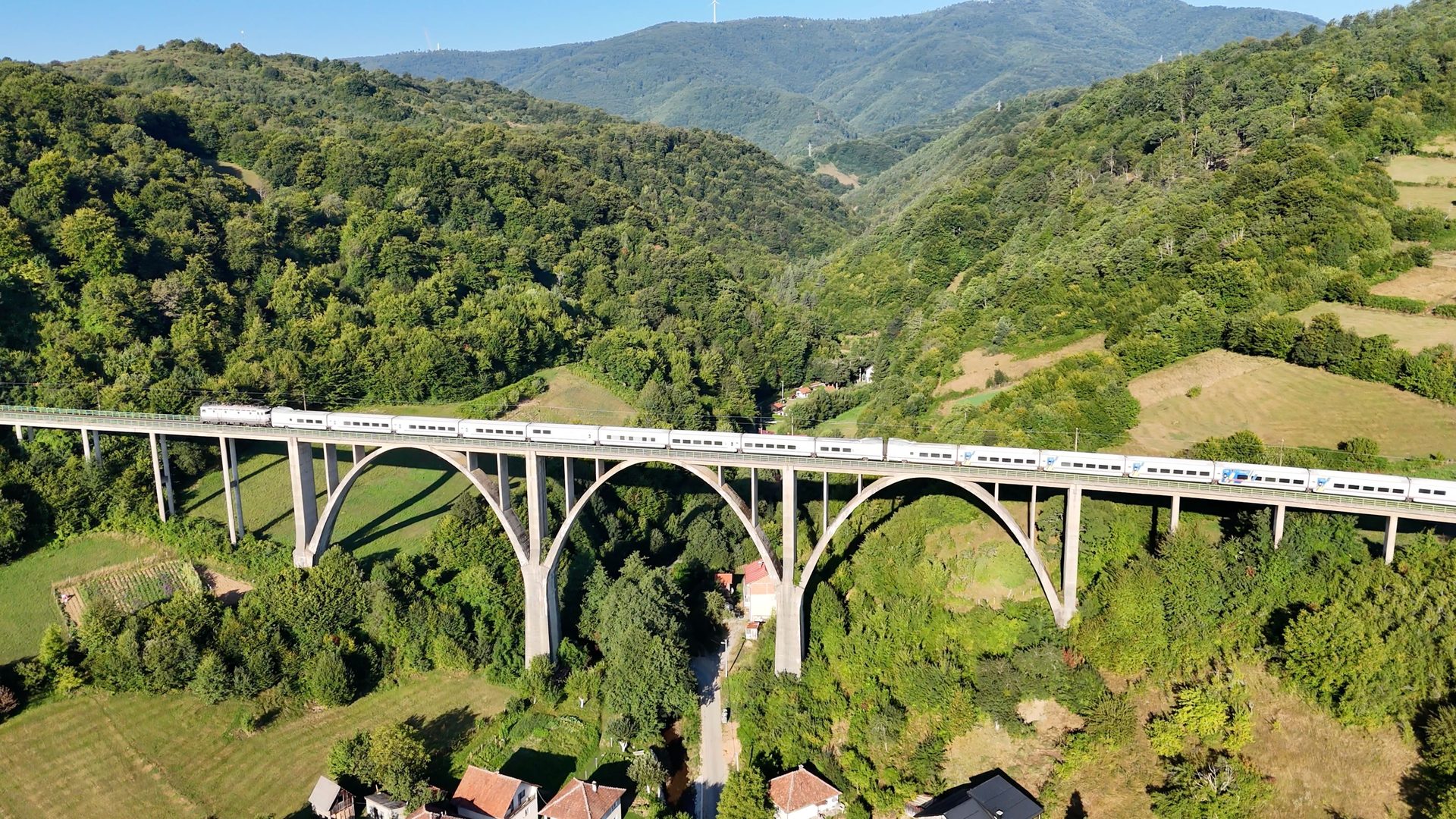
A ŽFBH Talgo VII trainset on the Sarajevo–Ploče line. Nine Spanish-built Talgos delivered in 2010 sat idle at Rajlovac depot for over six years before finally entering service in 2016 — and now anchor the international weekend service to the Adriatic.
Most "world's best train ride" lists feature the same handful of names — Bernina, Glacier Express, Flåm, Centovalli. Almost all of them are narrow-gauge tourist lines that exist mainly to be ridden. The Sarajevo–Ploče railway is something different: a 194.6 km, fully electrified, standard-gauge mountain mainline that hauls bauxite and steel and containers every day, and happens to traverse one of the most spectacular river canyons in Europe on the way.
In November 2025, after a 12-year gap, the international passenger service across the Bosnian–Croatian border was finally restored. There is no better moment to look closely at this remarkable line.
A railway built three times
The first train reached Sarajevo from the Adriatic on 1 August 1891 — but on a 760 mm narrow-gauge track. The Austro-Hungarian Narentabahn, opened in stages between 1885 and 1891, was a feat of mountain engineering that included two rack-rail sections and a 648 m summit tunnel under Mt. Ivan, the watershed dividing the Black Sea and Adriatic basins. It was on this line that Archduke Franz Ferdinand travelled from Metković to Sarajevo on 23 June 1914 — and on which his body was carried back a week later.
A partial modernisation came in 1931, when a new 3.22 km tunnel under Mt. Ivan replaced one of the rack sections. Crucially, that tunnel was deliberately built with a structure-gauge profile sufficient for future standard-gauge use. It would take another 35 years to make use of that foresight.
Studies for the standard-gauge replacement ran from 1948 to 1958. Construction proper began in 1958 and accelerated between 1961 and 1964 with a US $35 million credit from the World Bank. The first train on the new 1,435 mm line ran from Sarajevo to Mostar on 26 November 1966, and continued to Ploče the following day. Just two and a half years later, on 30 May 1969, the first electric train ran the full length under fresh 25 kV / 50 Hz catenary — making this the first 25 kV / 50 Hz electrified railway anywhere in the former Yugoslavia, predating both Croatia's and Serbia's first 25 kV electrics by a year.
For two decades, the line was a strategic Yugoslav success story. Then came 1992.
War, ruin, and a slow return
The last pre-war Zagreb–Ploče through service ran on 3 April 1992. By the end of the conflict, the automatic block, electronic interlocking and Rajlovac telecommand systems — Yugoslavia's most modern rail infrastructure — had been destroyed. ŽFBH's own estimates put aggregate damage to Bosnia's railways at around one billion US dollars.
Reopening came in pieces. The first ceremonial train ran in July 1996. The line entered the official passenger timetable in 1998. Sarajevo–Ploče through services returned in 2002. But Croatian Railways cancelled its Ploče–Čapljina passenger trains in December 2013, and the cross-border service collapsed.
Between 2015 and 2017, ŽFBH and an Italian-Bosnian consortium completed a €25 million overhaul of the 30 km Sarajevo–Bradina section, including a full rehabilitation of the Ivan tunnel — now engineered for 120 km/h, where speed had previously been restricted to 20 km/h. By summer 2017, daily Talgo trains were running again to Mostar and Čapljina. The international gap, however, remained unbridged until last year.
"Cloud-cresting scenery rivalling anything Switzerland or Norway has to offer." — The Guardian
The Neretva canyon
Pull out of Sarajevo's main station — the 1947–53 functionalist building is itself a national monument — and within twenty minutes you are climbing the Zujevina valley toward Ivan Sedlo. The 3,223 m Ivan tunnel takes you under the watershed at around 518 m above sea level. On the southern portal, the line drops 25 ‰ down to Konjic through 46 tunnels and 21 bridges in a single 30 km section. From here to the sea, the railway follows the Neretva.
The canyon between Konjic and Mostar is what places this line in the same conversation as Bernina or Flåm. The Jedrinje sector alone contains 11 viaducts, 9 galleries, and 6 tunnels, including the 3,218 m Jedrine tunnel — second-longest on the line. Across the full route, ŽFBH counts 71 bridges totalling 3.7 km, and 106 tunnels totalling 36.6 km of structures. The river crosses the train, or the train crosses the river, again and again — six times between Jablanica and Ploče by my count.
For southbound passengers, the river views are mostly on the left side of the train. Northbound, they are mostly on the right.
What runs today
The line is operated by two companies: ŽFBH on the 163 km Sarajevo–Čapljina section, and HŽ Infrastruktura on the 22.7 km Metković–Ploče section, with HŽPP running the international passenger service jointly with ŽFBH. Locomotives change at the border. Croatia's accession to Schengen on 1 January 2023 added external-EU border procedure to the crossing.
Freight remains the line's economic backbone. Aluminij Mostar runs a direct rail link to the Port of Ploče. ArcelorMittal Zenica's steel output moves north and south. The Croatian operator ENNA Transport reports that nearly two-thirds of its entire freight transport volume runs on the Ploče–Bosnia route — over 2 million tonnes a year.
The line has not had an easy 2024–25. On the night of 3–4 October 2024, catastrophic floods and a landslide near Donja Jablanica destroyed a railway bridge and damaged 17 km of track. ŽFBH lost an estimated KM 22.5 million in revenue. Repairs were donated and executed in almost exactly four months by the Turkish contractor Cengiz İnşaat after Bosnia's complex procurement processes proved too slow. Freight reopened on 30 January 2025; passenger service resumed on 10 February.
Then, on 9 November 2025, ŽFBH and HŽPP launched the new joint Sarajevo–Ploče service — three weekday pairs (Friday, Saturday, Sunday), running year-round, using ŽFBH's nine Spanish-built Talgo VII trainsets. The Friday afternoon train leaves Sarajevo at 16:46 and reaches Ploče at 20:15. The Sunday morning train leaves Sarajevo at 07:15. The summer seasonal pattern resumes from late June 2026.
A one-way ticket Sarajevo to Ploče costs 25.00 BAM (about €12.78). Return is 41.40 BAM, valid for one month. There are 30% concessions for students, journalists, pensioners, and groups of more than six adults; 50% for children, the blind, and groups over thirty. For Bosnian-origin passengers, the cross-border ticket must be purchased at a ŽFBH station before noon the day before travel — name, year of birth and passport number are passed to the border services in advance.
Why this line matters
The Sarajevo–Ploče railway is the backbone of Pan-European Corridor Vc and a component of the EU's TEN-T extended Mediterranean network. It is Bosnia and Herzegovina's only effective rail outlet to the sea. It crosses three former Yugoslav republics' worth of history in three and a half hours. Its scenery has been compared in The Guardian to "anything Switzerland or Norway has to offer." It is, despite everything that has happened to it, still working — still electric, still standard-gauge, still moving steel and containers and tourists between the Sava basin and the Adriatic.
It is, very simply, one of the great working railways of Europe — and one of the few that you can still ride for the price of a coffee in Vienna.
Sources: ŽFBH (zfbh.ba); HŽ Putnički prijevoz (hzpp.hr); Vremeplov.ba; Wikipedia (en, bs, hr, de) "Sarajevo–Ploče railway"; The Guardian; Croatia Week; Sarajevo Times; ENNA Transport; EBRD project documentation; Hidden Europe Magazine.