Slovenia
Jesenice to Nova Gorica Cab Ride
Watch on YouTubeAbout this journey
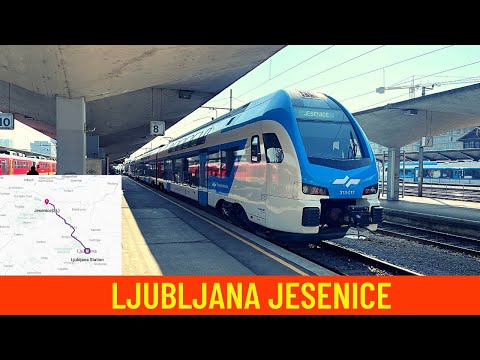
Jesenice station sits in the Sava Dolinka valley, close to the borders with Austria to the north and Italy to the west. It became a railway junction in 1906, when two lines of the Cisleithanian New Alpine Railways project were completed simultaneously: the Bohinj Railway toward Trieste and the Karawanks Tunnel route to Villach. The station building visible today dates from a rebuild carried out between 1953 and 1955 to designs by architect Stanislav Rohrman, replacing a structure destroyed in early 1945 — a stark modernist composition faced in white marble with hexagonal windows.
The Bohinj Railway itself was constructed by the Austro-Hungarian Empire at the beginning of the twentieth century to strengthen links between the imperial interior and the Port of Trieste, with the Jesenice–Trieste section inaugurated on 23 July 1906. The line's western terminus, Nova Gorica station, carries a dense historical weight: it changed name five times after opening in 1906 as Austrian, Italian, German, Yugoslav, and Slovenian administrations succeeded one another. The station faces Transalpina Square, which marked the border between Nova Gorica and the Italian city of Gorizia from 1947 until Slovenia entered the Schengen area in 2007. Nova Gorica itself is a planned town built after 1948 to modernist principles, conceived after the 1947 Paris Peace Treaty placed historic Gorizia on the Italian side of the new frontier.
Route
- Start Jesenice
- End Nova Gorica
- Distance ~88.8 km
- Filmed 2022-03